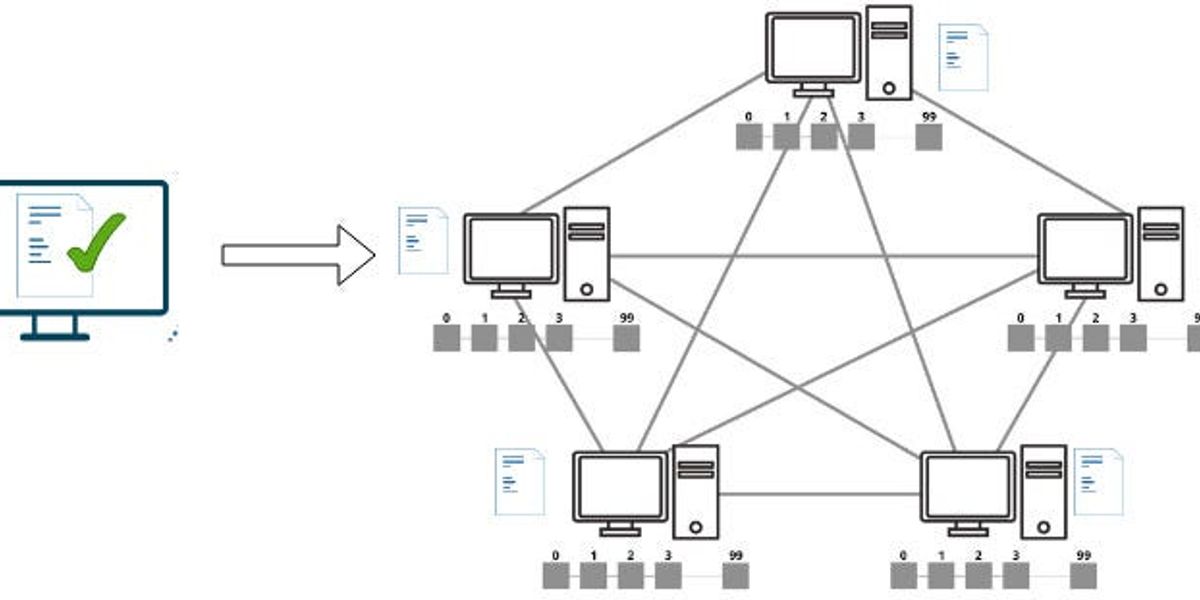
A user opens an application. They record an action. They click a button. A moment later the screen says: transaction confirmed.
It looks simple. But several things happened underneath.
A request was created. Authorization was provided. The network received it. The network checked it. Rules were applied. An accepted result became part of the blockchain's history.
What happened between the click and the confirmation?
It starts with a request
Imagine a manufacturer has finished producing a batch of products. Custody is being transferred to a distributor. An authorized employee opens the company's application and records the transfer.
At this moment, nothing has changed on the blockchain yet. What the application has done is create a transaction request.
A transaction is a request to record or change something according to the rules of the blockchain system. In this case, it represents the transfer of a product from one party to another. The request exists. Now it needs to be authorized and validated before it becomes part of anything.
How does the network know who authorized it?
This is where a concept called a private key becomes important.
A private key is a secret piece of cryptographic information associated with a blockchain account. It is used to authorize actions on behalf of that account. It should never be shared with anyone else.
When the employee submits the transaction, the application uses the private key to create a digital signature for that transaction. A digital signature is a form of cryptographic proof that a specific action was authorized by the holder of a particular private key.
The network can verify that signature without ever needing to see the private key itself. This is an important distinction. The private key is not sent to the network. Only the signature travels with the transaction, and that signature can be checked mathematically against the account it claims to represent.
Think of it as a unique authorization stamp that can be verified by anyone who needs to check it, without revealing the stamp's original seal.
The transaction reaches the network
Once signed, the transaction is submitted to the blockchain network. Participating computers receive information about the request.
They do not simply accept it because someone submitted it. The transaction is checked.
Is the digital signature valid? Is this account permitted to perform this action? Does the transaction follow the network's rules? Does the requested action make sense based on the current recorded state?
These checks happen before anything is accepted. A transaction that does not pass them does not proceed.
Valid does not immediately mean final
This is a distinction that many explanations of blockchain skip over, and it matters.
Passing initial checks does not mean a transaction is instantly and permanently part of the blockchain. Depending on the network, valid transactions go through a process of ordering, inclusion, and confirmation. Different networks handle this differently, and some applications wait for the network to progress further before treating an action as fully settled.
The blockchain has rules for determining which valid transactions become part of its accepted history and in what order. That process varies, but the principle is the same: submission and confirmation are not the same event.
The blockchain is updated
When the transaction is accepted and included, the blockchain's recorded state reflects the new event.
In the supply chain example, the transfer is now recorded. The manufacturer transferred the product. The distributor received it. The relevant participants can reference the accepted record. Depending on the blockchain, multiple participating nodes update their view of the shared ledger accordingly.
The event is now part of the history that subsequent transactions will build on top of.
What confirmed actually means
When an application shows a confirmation, it generally means the transaction has been accepted and included according to the network's rules. Some applications wait for additional network progress before displaying this, depending on what level of finality the situation requires.
Finality refers to the point at which a blockchain transaction can be treated as settled according to the network's design. Different networks reach finality differently and at different speeds. The practical implication is that submitted and confirmed mean different things, and well-designed applications account for that distinction.
The user may never see any of this
The employee using the supply chain application may simply see: product transferred successfully.
They do not need to think about private keys, digital signatures, network validation, transaction ordering, or finality. They recorded a transfer. It was accepted. They can move on.
Good software hides complexity that users should not need to manage. Just as people use online payment systems without understanding the infrastructure processing each transaction, users of enterprise blockchain applications should not need to understand the engineering underneath to complete everyday tasks.
Complex infrastructure should not create a complex experience.
About Wave Group
Building a blockchain application involves more than deploying smart contracts or connecting to a network. The full transaction journey matters at every step.
Wave Group approaches blockchain systems by considering how an action is initiated, who is authorized to perform it, how keys are handled securely, what information belongs on-chain, what happens when a transaction fails, how the blockchain connects with existing business systems, and what the end user actually experiences.
The blockchain layer should work as part of the wider application architecture. The goal is not to expose blockchain complexity to the people using the system. It is to use blockchain where its properties solve a real problem while keeping the experience simple for everyone involved.
From the user's perspective, it might take one click. Behind that click is a carefully designed process for proving authorization, validating information, and reaching an accepted result.
The best blockchain applications make that complexity almost invisible.
