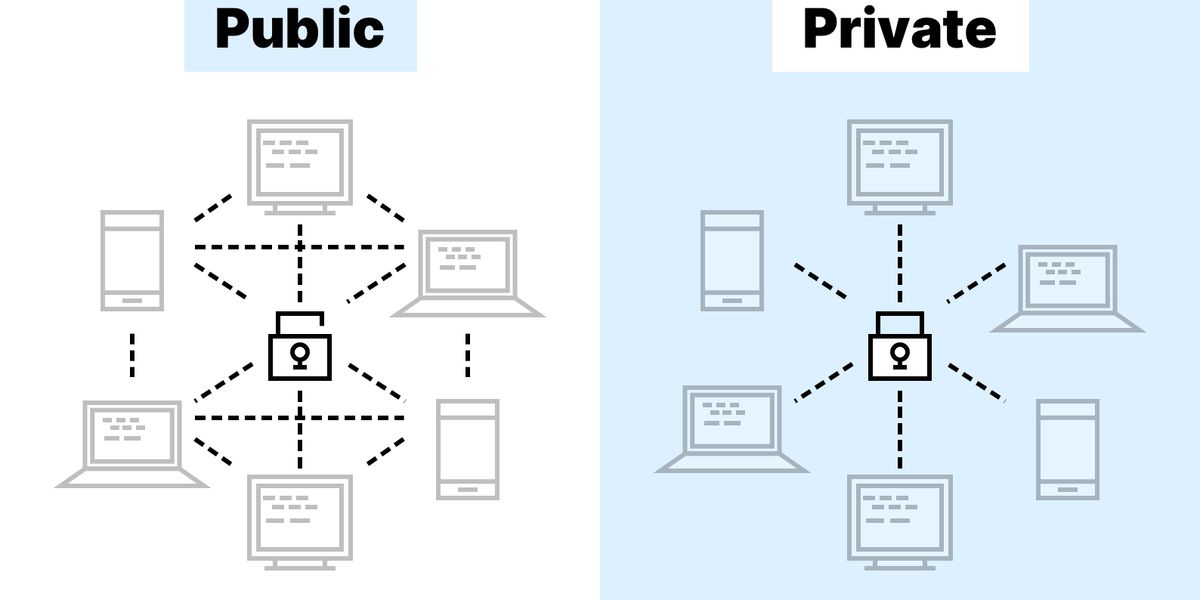
When people hear the word blockchain, they often picture a vast open network where anyone in the world can participate. That describes some blockchains. But not all of them.
A blockchain can also be designed for a specific group of organisations, institutions, or approved participants. This leads to two broad approaches that are worth understanding clearly.
What is a public blockchain?
A public blockchain is designed so participation is broadly open according to the network's rules. Depending on the network, people may be able to view activity on the blockchain, submit transactions, use applications built on top of it, or participate in maintaining the network if they meet its requirements.
Ethereum is one of the most widely known examples. The important characteristic is open participation. No single company decides who is allowed to use the overall network.
Openness is the defining feature, not a side effect.
What is a private blockchain?
A private blockchain restricts who can participate. An organisation or group of organisations decides who has access to the network and what those participants are permitted to do.
Imagine a blockchain shared between a manufacturer, a logistics company, a distributor, and a retailer. The network is designed specifically for those organisations. The broader public does not have access. Each participant may also have different permissions. One organisation might create records. Another might confirm them. A third might only be allowed to view certain information.
Participation is controlled rather than open to everyone.
What does permissioned mean?
A permissioned blockchain is one where participation or certain actions require authorization. The terms permissioned and private often appear together in business conversations, but they do not always mean exactly the same thing.
A network might make certain information broadly visible while still restricting who is allowed to validate transactions or update records. The key idea is that blockchain access and blockchain permissions can be designed in different ways, independently of each other.
The core difference: who gets to do what
The most practical way to understand the distinction is through four simple questions.
Who can join? Public networks allow broad participation. Private networks restrict it to approved participants.
Who can submit or validate information? Public networks follow open rules. Private systems assign specific roles and responsibilities to specific participants.
Who can see the information? Public blockchain activity may be broadly visible, though what exactly is visible depends on the network and how the application is built. Private systems can limit information to authorized parties.
Who decides how the network operates? Public networks rely on community or protocol-based governance. Private networks may have governance agreed between the participating organisations.
Why would a business choose a private network?
Imagine several companies need to share records and verify important information between them. They want the benefits of a shared ledger but do not want confidential business data visible to the world.
They may also need known participants, defined access rights, clear governance, and privacy controls. A permissioned blockchain architecture often makes practical sense in that environment.
The reason is not that private is inherently better. It is that the architecture needs to match who should be participating and what they should be allowed to see and do.
Why would a public blockchain be the right choice?
Public blockchains can make sense when open participation is itself part of what the application needs. Broad accessibility, public verification, a network that no single organisation controls, or interoperability with a wider ecosystem are all characteristics that certain applications depend on.
Neither architecture is universally better. They serve different purposes.
It is rarely a simple either-or choice
Real blockchain architecture often combines approaches. Sensitive business information might remain inside private enterprise systems. Verification information might be recorded through a blockchain. Some actions might be restricted while other information is publicly verifiable.
The design follows the requirements rather than fitting everything into a single model.
About Wave Group
Wave Group does not begin a blockchain project by deciding that the answer must be public or private. The starting point is understanding the participants and what the system needs to accomplish. Who needs access? What should each participant be allowed to do? What must remain private? Does public verification create value for this application? How should governance work between the organisations involved?
Once those questions have clear answers, the right architecture can be designed.
The better question is never simply public or private.
It is who needs to participate, what they need to do, and what the system is actually trying to achieve.
