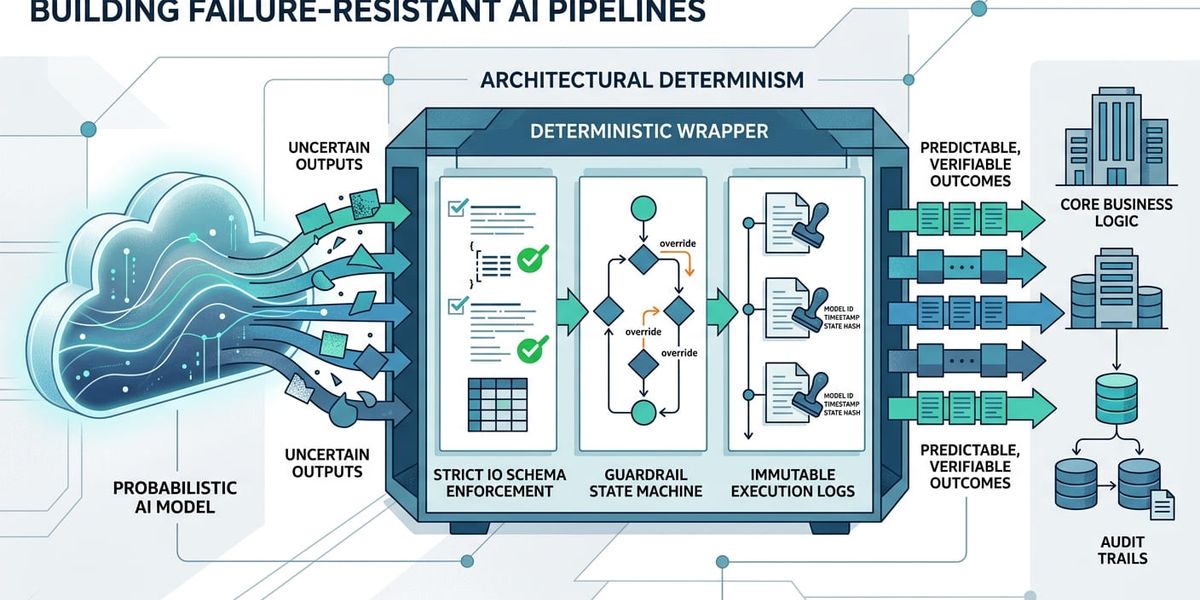
When enterprises integrate artificial intelligence into core operational workflows, they often treat non-deterministic model outputs as an acceptable tradeoff for flexibility. While creative tasks thrive on fluid, generative responses, core business operations—such as supply chain routing, automated financial reconciliation, and contract compliance—demand absolute predictability.
Relying purely on probabilistic AI outputs in mission-critical software creates a fragile architecture where rare edge cases can cause catastrophic operational failures.
To build enterprise-grade automation, technical systems must shift toward architectural determinism—a design pattern that wraps probabilistic models inside strict, mathematical execution boundaries.
The Failure Modes of Probabilistic Automation
Deploying pure machine learning models directly into production systems without deterministic controls introduces three primary structural risks:
Cascading Downstream Failure: A single hallucinated value or malformed JSON payload from an upstream model can corrupt downstream database schemas and break automated background jobs.
Non-Reproducible Audit Trails: When system behaviors change unpredictably across execution cycles, compliance teams cannot retrace decision paths or satisfy regulatory audit requirements.
Unbounded Operational Scope: Without hard structural limits, AI agents can execute over-privileged API calls or commit resources beyond authorized thresholds.
Designing the Deterministic Wrapper
Architectural determinism does not eliminate machine learning; rather, it enforces strict operational constraints at every stage of the execution pipeline.
Modern enterprise integration patterns enforce determinism across three distinct layers:
Strict Input/Output Schema Enforcement: Every request and response passing through an AI service is validated against static, type-checked schemas (such as Pydantic models or JSON Schema). Any response failing structural validation is instantly rejected before reaching core business logic.
Deterministic Guardrail State Machines: Before an automated decision is executed, it passes through a hard-coded finite state machine. If an AI recommendations engine suggests an action outside predefined risk parameters, the state machine automatically overrides the request and routes it to human review.
Immutable Execution Logs: System state changes are recorded on immutable, append-only ledgers. This guarantees that every automated action is anchored to the exact model version, input context, and system state present at the moment of execution.
Engineering for Absolute Reliability
True enterprise transformation is not achieved by deploying speculative, unconstrained algorithms into production environments. It is built on invisible, deterministic infrastructure that guarantees consistent, verifiable execution every single time.
By enforcing strict architectural boundaries around dynamic models, organizations gain the full cognitive power of modern AI without sacrificing systemic stability or operational control.
